The Dearborn Inn
Also known as: Dearborn Inn and Colonial Homes
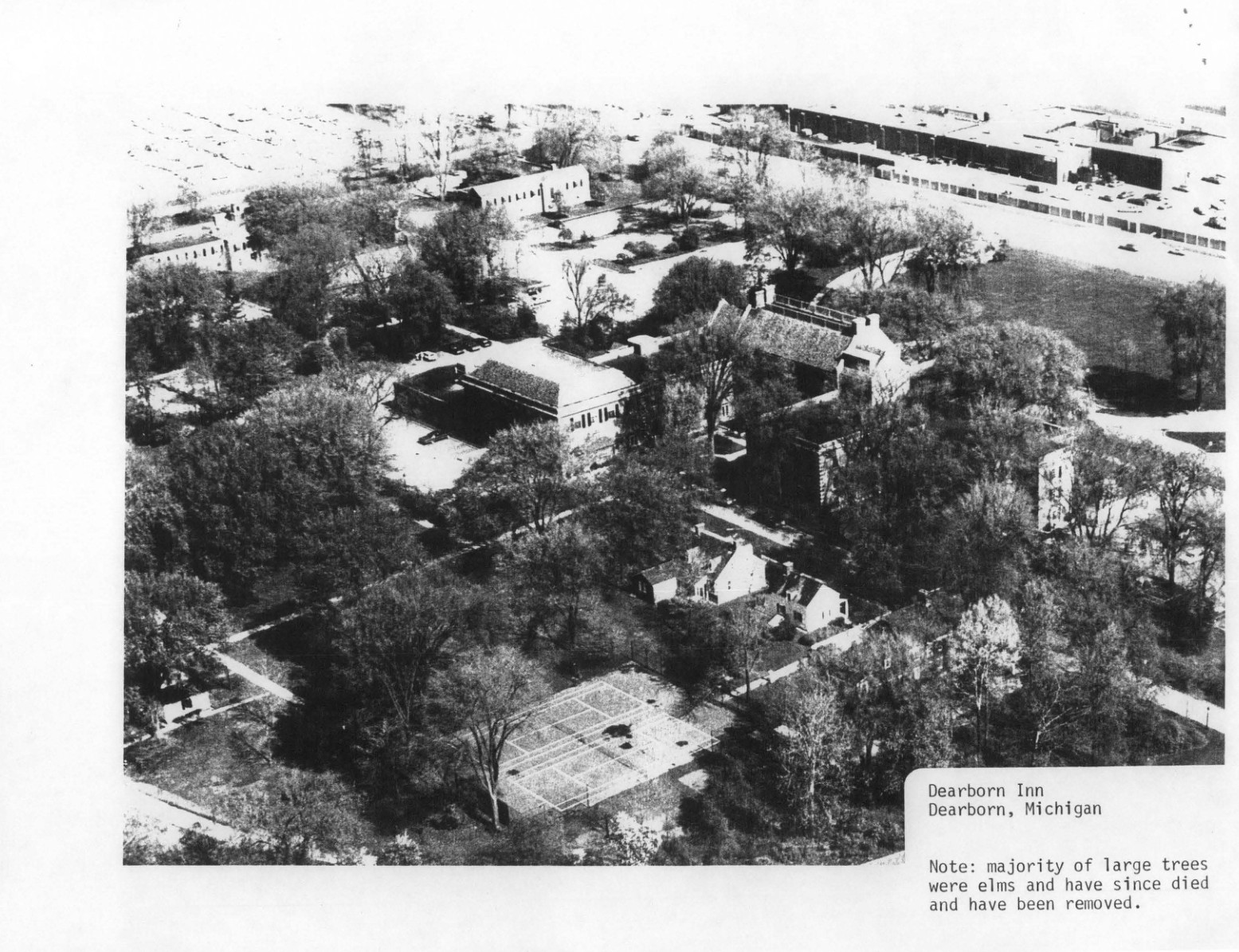
Historic Photo from NRHP Filing
Dearborn Inn Dearborn, Michigan Note: majority of large trees were elms and have since died and have been removed.
National Register of Historic Places Filing
The Dearborn Inn was built in 1931 by Henry Ford to service passengers arriving and departing from the Ford Airport in Dearborn. Built directly across the street from his airport, Ford's Dearborn Inn is significant as the first airport hotel in the country; a hotel designed and built specifically for the air traveler. Ford's airport, in operation from 1924 until 1933, ushered in a new era of flight, embracing the all-metal airliner, radio control devices, air mail, schedule flights, passenger terminal, passenger accommodations and the airline services that the generation of the 1930s came to expect. Henry Ford called upon Albert Kahn to design the hotel building in a refined Georgian style to blend with the nearby Edison Institute (Henry Ford Museum and Greenfield Village, National Historic Landmark).
The hotel's accommodations were expanded in 1937 with the construction of a historic village to the south of the inn. The village originally was planned to contain eighteen buildings, all reproductions of homes of noted Americans. However, with the onset of World War II only five buildings were constructed. The five constructed are reproductions of the Walt Whitman House, Melville, Long Island, New York; the Edgar Allen Poe House, Fordham, New York; the Barbara Fritchie House, Frederick, Maryland; the Oliver Wolcott House, Litchfield, Connecticut, and the Patrick Henry House, Red Hill, Virginia.
Architect Charles M. Hart of New York was responsible for the village layout and house reconstructions. The village concept is a direct reflection of Henry Ford's nearby Greenfield Village which the hotel served and exemplifies the historic preservation thinking of that time as evidenced in Greenfield Village and John D. Rockefeller's Colonial Williamsburg.
Physical Description
The Dearborn Inn and Colonial Homes is a hotel complex comprised of the inn building, designed by Albert Kahn and built in 1931, the staff dormitory building, built in 1931, and five colonial house reproductions built in 1937. The Dearborn Inn was built directly across from Henry Ford's Airport and down the road from the Edison Institute (Henry Ford Museum and Greenfield Village, NHL) in what was an open farm land area several miles from downtown Dearborn. The inn building is a three story, gable roofed, red brick Georgian style building flanked by two story, flat roofed wings. Directly west of the inn is the dormitory building, which housed the staff required to operate the inn.
This is a two and one-half story, gabled roof brick building designed in simplified Georgian style to harmonize with the Inn. Directly south and behind the inn building are five reconstructions of Colonial homes arranged in a village-like setting. These buildings are reconstructions of homes of noted Americans; the Walt Whitman House, a two story, brick Federal style building; the Edgar Allen Poe House, a one and one-half story shingle cottage; the Barbara Fritchie House, a one and one-half story brick cottage; the Oliver Wolcott House, a two story, frame, Federal style building; and the Patrick Henry House, a two story, frame Federal style building with symmetrical flanking wings. Each building is an exact exterior reproduction of its namesake's house while the interiors are modified to provide hotel accommodations.
Care was taken in designing the interior spaces to reproduce and incorporate much of the original detailing including door and window trim, staircases, fireplaces, paneling and wainscoting.
Architect/Builder
Albert Kahn, Architect; A. A. Albrecht, builder
NRHP Ref# 82000549 • Data from National Park Service • Content available under CC BY-SA 4.0
Historic Photos
(18)Sourced from the National Register of Historic Places filing
The Dearborn Inn—Dearborn Inn Dearborn, Michigan Note: majority of large trees were elms and have since died and have been removed.
Public Domain (Michigan Filing)
Building Details
- Architect
- Albert Kahn
- Year Built
- 1931
- Style
- Neo-Georgian
- Building Type
- hotel
- National Register
- Listed 1982
- Ref# 82000549


