Thomas A. Parker House
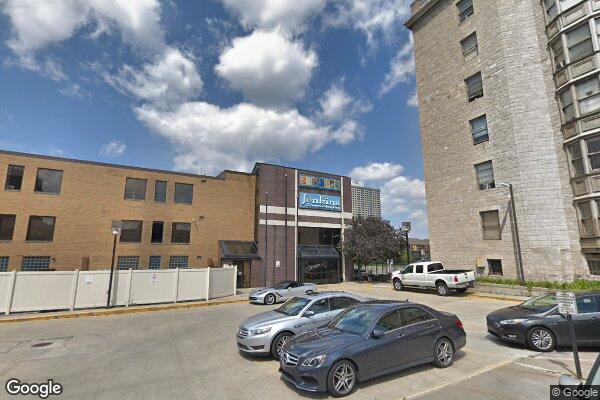
Google Street View — No original photos yet
National Register of Historic Places Filing
The Parker House, built in 1868, is significant as a rare example of Gothic Revival style of residential architecture surviving in Detroit. Thomas Augustus Parker, a successful wholesale grocer and a real estate developer, commissioned well-known Detroit architect Gordon W. Lloyd to design his residence on prestigious Jefferson Avenue. Lloyd, born and trained as an architect in England but reared in Canada, was influenced by northern Gothic architecture and English Victorian Gothic.
He came to America in 1858 at a time when A. J. Downing was espousing his and his friend A. J.
Davis' philosophies on the virtues of the Gothic villa, resulting in the romantic, asymmetrical appearance of residential architecture and landscape design which swept the country in the 1840s, 50s and 60s. Lloyd's propensity towards the medieval fit right in with this American architectural fashion. The Parker House is an excellent example of the high quality Gothic Revival designs Lloyd produced during that period. Parker and Lloyd's association did not end with the Parker House, for in 1883 Parker hired Lloyd to design the cast-iron front Parker Block at the southwest corner of Woodward and State in Detroit.
Physical Description
The Parker House is a Gothic Revival style building built in 1868 on Jefferson Avenue, once one of Detroit's most fashionable residential avenues. Detroit architect, Gordon W. Lloyd chose Kelly Island, Lake Erie, grey limestone as the primary building material with Amherst, Ohio, sandstone for trim. Located just east of Detroit's central business district, the Parker House is partially obscured from view due to its position between the later-built Automotive News Building and Lakeside General Hospital, both extending to the limits of their south (street) lot lines.
The exterior retains its original Gothic Revival form though the steeply pitched, imbricated slate-covered intersecting hipped and gabled roof has been covered with asphalt roofing and two shed dormers were added in the 1920s. A rear corner brick addition housing an elaborately paneled dining room was added between 1868 and 1888. The interior of the building has recently been rehabilitated for office use, retaining all original features extant including decorative paneling woodwork, floors and staircases. Only the main (south) facade is visible from Jefferson Avenue due to the later construction of buildings on either side.
This main facade is divided into three bays, with double transverse gables over the east and west bays. Each gable end is punctured with one double-hung sash window with a hood molding above. The facade is asymmetrical in design with the east bay exhibiting a first-floor, three-sided bay window with a decorative parapet above. A Tudor arch opening with double doors, transom and sidelights conforming to the arch shape comprises the entranceway in the central bay.
Double French doors lead onto a balcony with a decorative parapet on the second floor above the entrance. The west bay, projecting less than the east bay, has one pair of double-hung windows on each floor. The second story of the east bay also has a paired window. The central bay is surmounted by a slender gabled dormer.
The original imbricated slate roof has been covered with black asphalt roofing and the iron roof cresting was removed and stored in the building. An early two and one-half story brick rear addition to the Parker House has a three-level porch and fire escape staircase attached. The interior of the Parker House was remodeled several times for various uses including art studio, office, and apartments use. However, its tall ceilings, decorative cornices, woodwork, floors and paneling and staircase remain and have been restored in a recent rehabilitation of the building for office use.
Architect/Builder
Gordon W. Lloyd
NRHP Ref# 82000552 • Data from National Park Service • Content available under CC BY-SA 4.0
From Wikipedia
The Thomas A. Parker House was built as a private residence and is located at 975 East Jefferson Avenue in Detroit, Michigan. The house was listed on the National Register of Historic Places in 1982. It is currently the law offices of Liddle Sheets Coulson P.C.Thomas Augustus Parker was born in New York and came to Detroit with his brother in 1845.
The two established a successful wholesale grocery business, enabling Parker to grow wealthy. After his retirement, he invested most of his grocery profits in real estate, and was said to be worth $750,000 in 1895.Parker bought the land on which this house sits in 1867 and, in 1868, commissioned architect Gordon W. Lloyd to build what is now a rare example of a Gothic Revival house in Detroit. Parker lived in the house until his death in 1901.
In the 1920s, the house was leased to the Advertisers Bureau by Parker's daughter, and in 1928 it was sold. The building was later used as an artist studio, offices and an apartment building. In 1957 it was sold again, and used as offices, a reading room, a hospital record room and four apartments. It was later turned into the law offices of Liddle Sheets Coulson P.C.The house is built from Kelly Island grey limestone, with sandstone from Amherst used as trim.
The front façade is asymmetric, with three bays. The central bay holds an arched double-door entranceway on the first floor, and above, double French doors leading to a balcony. The side bays have transverse gables, with the east bay containing a first-floor bay window.• Liddle Sheets Coulson P.C.See also: Architecture of metropolitan Detroit
Content available under CC BY-SA 4.0
Building Details
- Architect
- Gordon W. Lloyd
- Year Built
- 1868
- Style
- Gothic Revival
- Building Type
- house
- National Register
- Listed
- Ref# 82000552


