Ford Highland Park Plant
Also known as: Ford Model T Plant, Highland Park Ford Plant
Photos
(3)
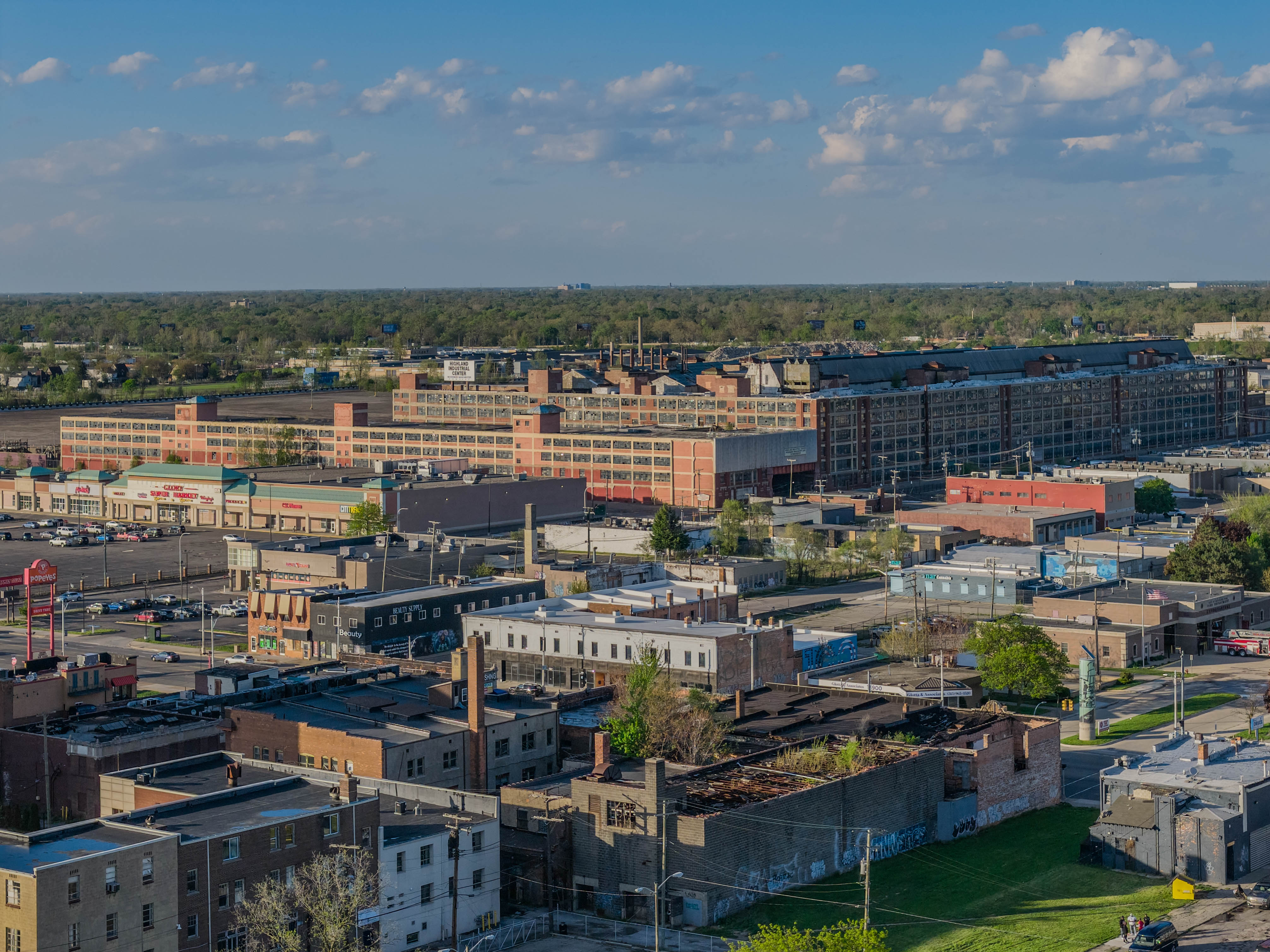
Ford Highland Park Plant — historic landmark photograph, 1909 Albert Kahn Industrial / Reinforced Concrete, 91 Manchester Avenue, Detroit. Photo by Andrew Petrov
 Own this photograph — hand-signed prints from $50Free U.S. shipping · ships same-day on most orders
National Register of Historic Places Filing
Although most Americans probably remember Henry Ford best for his Model T, his "unique achievement," according to distinguished historian Daniel J. Boorstin, "was less in designing a durable automobile than in organizing newer, cheaper ways to make millions of one kind of automobile. He transformed the making of automobiles from a Jerking, halting process to a smooth-flowing stream." 1 After the founding of the Ford Motor Company in 1903, Ford and his engineers made significant breakthroughs in improving and speeding up auto assembly methods by developing new machinery and placing men and materials on the factory floor in such a manner that bottlenecks were eliminated and production was increased. In 1910 the Ford Motor Company moved its operations to the new Highland Park Plant, and here, over the next 5 years the principles of modern mass production were developed by constantly rearranging men, machinery, and materials to systematize production, reduce unnecessary motion, and cut costs. In 1913 Ford and his engineers developed the continuously moving assembly line, "the crowning achievement," says company historian Allan Nevins, "in the creation of mass production techniques."2 This technique reduced the assembly time of a completed automobile from 728 minutes to 93 minutes. Over the years, the company constantly refined its methods until by 1920, a Model T could be produced each minute of the working day. Ford assembly techniques reached their zenith on October 31, 1925, when Model T's rolled off the line at the rate of one every 10 seconds. The economies of scale realized by Ford by concentrating on one car and reducing its manufacturing costs enabled him to reduce prices and increase his sales with each passing year. By 1924 the price of the Model T, which had been $850 in 1908, had dropped to $260. This car, says Ford biographer William Greenleaf, "put the nation on wheels, enormously accelerated
the urbanization of America, and ultimately brought the motor transportation revolution to other countries."3 The new production methods developed at Highland Park also made it possible for Ford to substantially increase the wages of his workers. His announcement of the "Five Dollar Day 11 on January 5, 1914, made him world famous and he soon became, according to intellectual historian Roderick Nash, "an international symbol of the new industrialism."^ The Highland Park Plant, according to Ford scholar David L. Lewis, "became f a national landmark and a new Niagara Falls, 1 a place to be seen by every visitor to Detroit."5 in Germany, the term "Fordismus" was coined to describe mass production, and in the Soviet Union Ford became something of a hero and was viewed more as a radical economic innovator than as a capitalist. In the 1920 f s Ford improved mass production methods even further at his gigantic River Rouge Plant. As a result of his work at Highland Park and the Rouge, Ford "more than any other single man," in the opinion of the noted technological historian
become the f arsenal of democracy 1 in the Second World War . . . because through the manufacture of twenty million cars over some forty years Ford had evolved a certain pattern for all large-scale production including that of the atomic bomb."° The Highland Park Ford Plant, the birthplace of the moving assembly line, is situated in an industrial area near northwest Detroit. Designed for the most part by noted industrial architect Albert Kahn, the plant from 1910 to 1927 was the scene of numerous advances in the development of mass production techniques. In recent years portions of the plant have been demolished, but many significant buildings remain. They include
to Clara Bryant in 1888, Ford, for a time, operated a business selling firewood and lumber. His chief interests, however, were gasoline and steam engines, and he became increasingly interested in automobiles. In 1891 the Fords moved to Detroit where Henry became an engineer for the Edison Illuminating Company. In his spare time he experimented with developing a gasoline engine to power an automobile, and in 1896 he built his first car which he called a quadricycle. Continuing his experiments, Ford by 1899 had perfected a marketable automobile. With the backing of several wealthy Detroiters, he incorporated the Detroit Automobile Company to manufacture the vehicle, but by the fall of 1900, the firm had ceased operations due to a lack of sales. Late in 1901, shortly after Ford had attracted much publicity by defeating Alexander Winton in a Grosse Pointe auto race, the company was reorganized as the Henry Ford Company. Early in 1902, however, due to differences between himself and his backers, Ford left the company. Renamed the Cadillac Motor Car Company, this firm went on to earn a distinguished place in the annals of automotive history. By mid-1902 Ford, influenced by Ransom E. Olds 1 success with the popular priced Oldsmobile, had turned his attention to designing a low-priced vehicle with mass appeal. With financial backing from Alexander Y. Malcomson, Ford in 1903 launched the Ford Motor Company. Successful from the start, the company produced automobiles in several price ranges in its early years, but the excellent sales of the cheaper vehicles convinced Ford that the company should concentrate all its resources in this segment of the automobile market. His principal impediment, however, was a group of stockholders led by Malcomson who wanted the company to build expensive vehicles. In 1906 Ford and James Couzens, his able business manager, gained firm control of the company by purchasing the stock of Malcomson and his supporters. That same year, Ford placed his Model N, priced at $700, on the market. Its success, says Ford biographer William Greenleaf, "raised the net income of the company for the first time to more than $1 million, placed
the firm at the forefront of the industry, and showed that Ford was correct in his view that the future of the industry belonged to the quantity-produced small car."' Meanwhile, Ford and his engineers were developing, says historian George S. May, "a 'universal car,' an inexpensive car that would be light in weight, yet durable, simple to repair, and simple to drive anywhere, regardless of road conditions."" The culmination of this work came in 1908 with the introduction of the famous Model T. This car's "essential note was certainly utility, not beauty," says company historian Allan Nevins, "yet its very homeliness had an appealing quality . . . Its basic merit lay in a hitherto unmatched combination of lightness, simplicity, and power." Although the Model T was the handiwork of a dozen men, Ford, in Nevins 1 opinion, "contributed the guiding concepts and furnished the guiding hand."9 The Model T was phenomenally successful from the start largely because of its attraction to rural Americans, who from 1909 to 1916 were undergoing a period of great prosperity. This rural market, says Greenleaf, "gave the first sustained impetus to the car that was principally responsible for taking the automobile out of the luxury class and making it an inexpensive necessity for the common man." This vehicle "put the nation on wheels, enormously accelerated the urbanization of America, and ultimately brought the motor transportation revolution to other countries."* 0 Ford achieved this position of dominance, according to automotive historian John B. Rae, "because, instead of starting out to produce a car as cheaply as possible, he concentrated first on designing a car that would be suitable for the mass market and then turned his attention to the problem of cutting
CONTI NUA-noiM SHEET Highland Park »TEM NUMBER 3 PAGE five
manufacturing costs. "H In fact, says distinguished historian Daniel J. Boorstin, Ford's "unique achievement was less in designing a durable automobile than in organizing newer, cheaper ways to make millions of one kind of automobile . He . transformed the making of automobiles from a jerking, halting process to a smooth-flowing stream." 12 Since the company f s founding in 1903, Ford and his engineers had worked to improve and speed up auto assembly methods by developing new machinery and placing men and materials on the factory floor in such a manner that bottlenecks were eliminated and production was increased. In the first Ford plant on Mack Avenue in Detroit, crews of 2 or 3 men worked on 4 chassis simultaneously and sometimes assembled as many as 15 automobiles per working day. Soon this plant was too small, and in 1905 the firm moved to a larger factory on Piquette Avenue. Manufacturing techniques were further refined until by 1908, Ford was producing 101 cars per day. Despite these figures, which were amazing to most automobile manufacturers, Ford was not satisfied. In 1907 Ford purchased 60 acres of land (later increased to 230) in Highland Park, a small community several miles north of Detroit, for a new factory which would be designed in such a manner that production could be greatly increased. Although the new plant's design was largely the work of Albert Kahn, soon to be hailed as one of the Nation's leading industrial architects, a number of Ford engineers, particularly Edward Gray, influenced its design as well. Actual construction did not start until 1908 and proceeded slowly because of Ford's determination to finance building costs entirely out of company profits. On January 1, 1910, Ford operations were shifted to the Highland Park Plant (the house that Model T built), and here over the next 5 years the principles of modern mass production were developed. Ford and his associates, among whom were men ( c ont inued ) ,y% llJohn B. Rae, The American Automobile: A Brief History (Chicago, 1965), 59. 12Boorstin, The Americans: The Democratic Experience,
like Peter E. Martin, Charles E. Sorenson, Carl Emde, Clarence W. Avery, and future General Motors president William S. Knudsen, spent much of their time on the factory floor where they rearranged machinery, men, and materials in such a manner as to systematize production, reduce unnecessary motion, and cut costs. Machines were arranged according to their function in the manufacturing process rather than by type; overhead conveyors, gravity chutes, and belts were used to transport materials from one work station to another so as to bring the work to the man rather-than the man to the work; and each worker's task was constantly simplified by an increasingly minute subdivision of labor. The great breakthrough at Highland Park came in 1913 when Ford and his engineers developed the continuously moving assembly line, "the crowning achievement," according to Nevins, "in the creation of mass production techniques."^3 The first step in this evolution in manufacturing methods occurred that spring when a conveyor belt was installed for assembling flywheelmagnetos. The average time required to put together one of these devices was cut from 20 to 5 minutes by using 29 workers, each of whom had one simple task to perform. By December 1, a continuously moving final assembly line went into operation which reduced assembly time of a completed automobile from 728 minutes to 93 minutes. The company continued to refine its assembly techniques, until by 1920 a Model T could be produced each minute of the working day. Ford assembly techniques reached their zenith on October 31, 1925, when Model T's rolled off the line at the rate of one every ten seconds. The economies of scale realized by Ford in adopting these techniques enabled him to reduce the price of the Model T, greatly increase his sales, and made him by far the Nation's leading automobile manufacturer. In 1908 when he introduced the Model T, he sold 5,986 touring cars at $850 each, but in 1916, after the moving assembly line was fully implemented. Ford had raised his output to 577,036 and reduced his price to $360, a figure which declined to $260 in 1924 when production was well over the million mark. In 1917 Ford controlled over sy , \
Ford: the Times, the Man, the Company, 466.
1/N1TLD STATES DEPARTMENT OK THE INTERIOR FOR NFS USE ONLY
42 percent of the Nation's market for new cars and by 1921 had nearly 56 percent of total car sales. In fact, by this date every other automobile in the world was a Model T Ford. The new production methods developed at Highland Park also made it possible for Ford to substantially increase the wages of his workers. His announcement of the "Five Dollar Day" on January 5, 191^, made him a worldwide figure and he "was praised as the prophet of a new industrial order and highconsumption society," says Greenleaf, "when he pointed out that workers should be paid high wages so that they might buy the goods they produced." 14 The Highland Park Plant, according to Ford scholar David L. Lewis, "became 'a national landmark and a new Niagara Falls, 1 a place to be seen by every visitor to Detroit." 1 * In Germany, the term "Fordismus" was coined to describe mass production, and in the Soviet Union, Ford became something of a hero, "not as a capitalist," says automotive historian James J. Flick, "but as a revolutionary economic innovator. nl ° By World War I Ford had become convinced that the Highland Park Plant was outmoded. In addition to inadequate water and sewage facilities, the factory complex could not be enlarged sufficiently to produce a million cars yearly as Ford desired. Near Dearborn between 1919 and 1927 he constructed the River Rouge Plant, which he envisioned as an almost self-contained industrial city that would not only assemble greater numbers of motor vehicles more efficiently but would produce the basic components from raw materials as well. Gradually the focus of company operations shifted from Highland Park to the Rouge, a move which was virtually completed in 1927 when the final assembly line was moved to the new plant. In 1919 Ford gained total control of the company by buying out the other stockholders, giving him, according to Nevins, "industrial power such as no man had ever possessed before." 1 ?
Physical Description
The Highland Park Ford Plant, the birthplace of the moving assembly line, is situated in an industrial area near northwest Detroit. Designed for the most part by noted industrial architect Albert Kahn, the plant from 1910 to 1927 was the scene of numerous advances in the development of mass production techniques. In recent years some Highland Park structures have been demolished, but many significant buildings remain, including one of the factories where the first moving assembly line was installed in 1913 , seven factories designed specifically to take advantage of this new technique, a 1920 Office Building, and seven other factory and support structures constructed between 1910 and 1922. Most buildings are constructed of a combination of reinforced concrete and brick, sit on concrete foundations, have either flat, monitored or saw-tooth roofs, and exhibit many original architectural features. Although Ford's "Fairlane" Estate in Dearborn is already a National Historic Landmark and his River Rouge Complex is the subject of a separate inventory in this study, Highland Park is signally worthy because the techniques developed within its walls revolutionized manufacturing methods all over the world. When Henry Ford transferred his company's operations to Highland Park in 1910, the plant consisted of a four-story main factory building, a large four-story administration building, a gigantic power plant with five tall smokestacks all of which fronted on Woodward Avenue and have now been demolished and several other structures in various stages of completion. From 1910 to 1922 Ford and his colleagues constantly expanded the size of the complex as they developed new mass production techniques to meet the steadily increasing demand for the Model T. In a sense Highland Park was never completed because of Henry Ford's constant search for cheaper and more efficient production methods, which rapidly made machinery and factories obsolete. By World War I, the entire Highland Park Complex had become obsolete in Ford's mind because of the limited acreage available in the immediate vicinity of the plant*along with its limited water and sewage facilities, all of which militated against his dream of a vertically integrated industrial enterprise capable of manufacturing one million automobiles yearly. By this time Ford had begun to visualize the gigantic River Rouge Complex, and in the early 1920's he centered his energies on its construction. Gradually.the Rouge Plant surpassed Highland Park in size and importance, and in 1927 the final assembly line Troved to the new facility.
Despite its eclipse, Highland Park continued to play a significant role in the production of automotive components for the company and was also used to manufacture trucks. In 19^7 it became the principal facility for the manufacture of Ford Tractors and served in this capacity until 197^ when the tractor division was shifted elsewhere. At present, the plant is used primarily as a storage facility. Factory H. This four-story brick and reinforced concrete building, which is connected to factories W and X by two covered metal passageways located near the south end of its front (east) facade, is the oldest extant factory structure at Highland Park and one of the most historic. Completed around 1911, the 75-by~ 760-foot edifice was connected at the south end of its rear (west) facade with the original Highland Park factory, and the void between the two structures was filled by a one-story machine shop with a saw-tooth roof. In recent years, both of the latter structures have been demolished. Late in 1913, this factory became the site of the first moving automobile assembly line. A 191^ diagram shows that the third and fourth floors were used for preparing automotive components like fenders, gas tanks, hoods, wheels, tires, headlights, windshields, and floor boards for final assembly. Conveyors moved those to the second floor where they were assembled into car bodies. Another conveyor took the bodies to the first floor where they were connected to the chassis. A photograph taken during this era shows that occasionally (probably when the first floor had become too congested) final assembly took place outside the building. A special chute situated on the front (east) facade brought car bodies down to the chassis which were on John R Street. This structure has concrete foundations and is constructed of reinforced concrete faced with red brick. Exterior ornamentation is minimal except for the constrast provided by continuous piers and courses of concrete slab construction which set off ^; the steel sash windows, each of which contain 75 panes of *//O glass. These windows were one of Highland Park's most notable features, causing some to dub it the "Crystal Palace." The building is capped with a flat roof of concrete slab construction which has been covered with tar and gravel and has an overhanging
plain concrete cornice. The only major exterior changes to this structure have been made near its south end. The two bays at the extreme south end of the west facade situated at the point where the building was connected to the original Highland Park factory had to be bricked up when that edifice was demolished. Also, the upper two stories of the south end as well as part of the passageway leading to Factory W have been covered with blue-painted aluminum sheathing. Inside, the building still exhibits its original concrete floors and exposed steel beams. No original machinery remains, however. The building is vacant at present, and the Ford Motor Company plans to demolish it in the near future.
Factories W, X, Y, and Z and Craneways WX y XY, and YZ. These six-story structures of reinforced concrete and brick represent the first efforts to adapt factory design to the needs of the moving assembly line. Construction of Factories W and X started in July, 1913, shortly after the practicality of the moving assembly line had been proven by using it to assemble flywheel magnetos. These two structures were designed to utilize that principle to the utmost. Each factory measured 60 by 840 feet and were equipped with a wide variety of belts, chutes, and conveyors. Generally, the smallest automotive components were hoisted to the top floor where they then worked their way down to the first floor where final assembly operations took place. Raw materials and the finished product were handled by 40-by800-foot glass-roofed craneways situated between Factories W and X (WX Craneway) and on the north side of Factory X (XY Craneway). These craneways were also served by railroad tracks which made it possible to bring freight cars inside to unload raw materials and then fill them with the finished product. Those sections of the building facing the craneway had numerous landing stages on each floor to facilitate materials handling. Because of the success of this design, Factories Y and Z and Craneway YZ were subsequently constructed, after 1915, and theearlier structures were expanded in size'. In 1916 Factory W was lengthened 60 feet and Factory X 280 feet. In 1923 Factories Y and Z and Craneway YZ were extended 280 feet.
Because these buildings and their craneways are connected, they appear to be one gigantic factory. Exterior walls are constructed of reinforced concrete and are almost unadorned except at the corners which have been faced with brick in such a manner as to provide a sharp contrast with the continuous piers and courses of concrete slab construction which are the structured dominant feature. The steel sash windows are set in rectangular concrete surrounds and feature brick slipsills. Window sashes are pivoted top and bottom to allow them to take advantage of natural air currents. The factories are capped with reinforced concrete roofs covered with tar and gravel, and each factory roof has four penthouses, each of which contains a ventilating system unit. The craneways have lantern roofs which are covered with wired glass. Inside, these structures exhibit a number of original features like the concrete slab floors which were reinforced with twisted steel bars from the Cambria Steel Company. One of the most interesting features is the hollow column air distribution system which is still functional. Air from the ventilating, system on the roof was forced through 175 support columns, constructed of concrete and steel mesh, on each floor to provide heating and cooling. Although the craneways remain, they have been altered somewhat. Most of the landing stages have been removed as well as much of the railroad track which used to traverse them. Generally, these factories and their craneways have undergone little exterior alteration over the years except for the removal of their original machinery, and generally they are in good condition. Presently, they are used for storage. Factories 3, **, 5 and Tracks 13, !**» and 16. These one-story brick and concrete structures represent another shift in Henry Pord f s concept of factory design, one which would eventually spell Highland Park's doom as the center of the Ford empire. When Ford launched construction of Factories W and X in 1913, he made plans to build five others of similar design, but only two of these were actually constructed (Factories Y and Z). By 1918 he had become convinced that one-story plants were more efficient, and as a result, he built these factories and tracks with that principle in mind. Although these factories and
tracks have the same width as the older factories and craneways, 60 and 4o feet respectively, the newer ones were much longer— approximately 1,250 feet in contrast to the 840 feet of the earlier buildings. These structures are connected to the earlier factories at the north wall of Factory Z. In sharp contrast with the older buildings, these new edifices are almost completely devoid of exterior ornamentation and are purely functional. The tracks have lantern roofs covered with wire mesh glass similar to those of the old craneways, while the factories have saw-tooth roofs. All these buildings appear to be in good condition and are presently used for storage purposes.
Sales and Service Building and Executive Garage (00 Building and NN Garage). This rectangular-shaped four-story brick and concrete office, which fronts on Woodward Avenue, and the onestory brick and concrete garage connected to its rear (east) facade are the only remaining administrative structures at Highland Park. Constructed around 1920, the design appears to have been based on that of the somewhat larger 1910 Administration Building and Garage which stood approximately 400 feet south and was demolished a few years ago. The Sales and Service Building, which measures approximately 58 by 197 feet, has concrete foundations and walls of reinforced concrete. It has more exterior ornamentation than most Highland Park structures. The expanse of concrete is relieved by sheathing the north and south ends and the corners of the front and rear facades with red brick. At the base of its second story, the structure features a continuous concrete slab course which encompasses the roof line of the Executive Garage before ending abruptly at the west wall of Factory AA. The edifice's vertical piers rise uninterrupted to the top of the fourth floor where they culminate in an entablature featuring blue inlaid tiles and a dentiled cornice. The roof is of concrete slab construction and is covered with a mixture of tar and gravel. With the ex- *- ception of the show windows on the first floor, windows are of ',;;. the one-over-one wood sash variety with transoms and are set in rectangular surrounds.
UNITtD STATES DEPARTMENT Oh THt INTERIOR FOR NFS USE ONLY
The interior of this structure has undergone extensive change over the years. Its original woodwork has been removed, and it is presently paneled with metal painted to resemble wood. Probably the only original features are its marble floors antf the pressed plaster ceiling of its lobby. At present, this building, which is still in good condition,is vacant. The 46-by-197-foot Executive Garage spans the area between the Office Building and Factory AA and appears to be a onestory extension of the former. It has a steel truss roof covered with tile and is capped with a one-story monitor. Overall, this structure is in good condition. Factory AA. This four-story brick and reinforced concrete building, which is connected on its front (west) facade with the Office Building f s Executive Garage, was probably the last multistory factory building constructed at Highland Park. Completed around 1917, this 75-by-4l8-foot structure was connected to the 1910 factory at its south end, and was similar to it in design. As on the earlier edifice, exterior ornamentation is minimal except for red brick facing on first floor piers and on the corner bastion near the structure's north end and an overhanging bracketed concrete cornice near the roofline. One of its most notable features is its steel sash windows which are nearly 20 feet in width and vary in height from about 7 to 11 feet. The edifice is capped with a flat concrete slab roof covered with a mixture of tar and gravel. The only major exterior change has occurred at the building's south end which has been bricked up due to the demolition of the 1910 factory. Presently this structure is used to house the records of the Ford Motor Company and is almost completely filled with cardboard boxes holding company files which date back to its founding in 1903. Generally speaking, this structure's overall condition can be described as very good. Building 076. Situated approximately 1,000 feet east of Factory AA,~this one-story reinforced concrete structure served as a storage facility for completed Model T's. Constructed around 1922, the 60-by-600-foot edifice was served by a railroad track at its east end, making it possible to easily load completed vehicles despite inclement weather. The building's
gable roof is constructed of wood which has been coated with tar and gravel. Presently this structure, still in good condition, is vacant. Building K. This two-story irregularly-shaped brick and reinforced concrete structure, situated approximately 175 feet south of Building 076, also served as a storage and shipping facility for Model T's. Constructed around 1910, the l48-by-l,260-foot edifice was similar to the factories in the use of brick facing for decorative purposes, the use of large steel sash windows, and the use of concrete slab covered with tar and gravel for roof construction. In 1959 the building was lengthened to 1,5^0 feet by the construction of a one-story addition (Building 098) at its west end. Presently, this structure, still in good • condition, stands vacant. Building 072. This one-story rectangular-shaped brick edifice, constructed around 1922 and located east of Factory W and near the corner of Oakland and Manchester Avenues, served as a storage facility during the Model T era. Measuring 80 by 4l6 feet, this structure has a steel truss roof covered with tar and gravel and capped with a one-story monitor. Presently, this building, still in good condition, is vacant.
For the most part, Highland Park is well maintained, and the structures there are in good condition. Also, the surrounding neighborhood appears to be stable. The future of the plant remains unclear, however, because the Ford Motor Company has not yet decided how to fully utilize it. The company considers it too inflexible for use as a production facility, and the present warehousing and storage operation uses only a small proportion of the total available space.
Boundary Justification. The boundary of the designated area includes the most historically significant structures and " '^ approximately 55 of the 103 acres in the' Highland Park complex.--^ Also within the boundary but not contributing to the national significance of the complex are a transformer situated north of the north wall of Factory H; 098 Building; Track 18; and WW Factory Annex.
Architect/Builder
Albert Kahn & Edward Gray
NRHP Ref# 73000961 • Data from National Park Service • Content available under CC BY-SA 4.0
Historic Photos
(1)Sourced from the National Register of Historic Places filing
Ford Highland Park Plant—all 3 have contract w / counsel 06 UDAG. City wd acquire 100 wt.. project. / / and clr. Sell it to investors which ford will supply grant to restore s.c. / who lease back. drawings.
Public Domain (Michigan Filing)
Photographer's Notes
Albert Kahn's 1909-1910 reinforced-concrete factory complex; the original Ford Model T plant where moving assembly line manufacturing was perfected. National Historic Landmark; NRHP-listed.
Building Details
- Architect
- Albert Kahn
- Year Built
- 1909
- Building Type
- factory
- National Register
- Listed 1973
- Ref# 73000961
Own a museum-quality print of the Ford Highland Park Plant — photographed by Andrew Petrov
Hand-signed prints from $50 · free U.S. shipping · ships same-day on most orders
Own this print — from $50 →