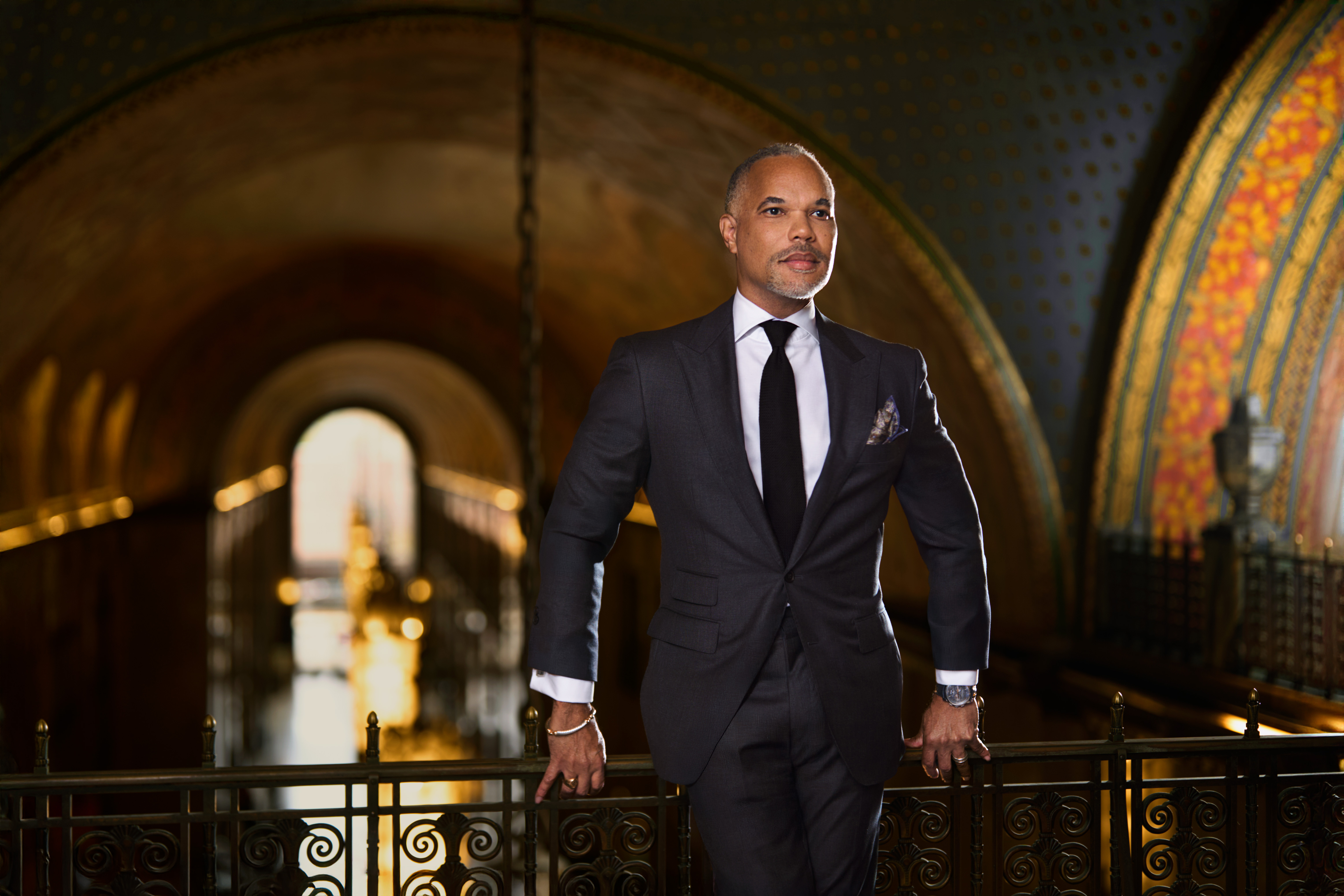
## Inside the Fisher Building
The Fisher Building stands at 3011 West Grand Boulevard in Detroit's New Center district, three miles northwest of downtown. Albert Kahn designed it for the seven Fisher brothers, owners of the Fisher Body Company that built automobile bodies for General Motors. It opened in 1928 and was added to the National Register of Historic Places in 1980 under reference number 80001922, with national-level significance in architecture, art, commerce, and industry. The Architectural League of New York gave Kahn its silver medal for the design, and the AIA Detroit chapter later named it Building of the Century.
The structure is twenty-eight stories at the tower with two eleven-story wings extending north and west, forming an L-shaped footprint. The first three floors are clad in polished dark gray Minnesota granite. The upper stories are grayish Maryland marble. All exterior metalwork — arcaded shop windows, door frames, ornamental panels — is solid bronze. The roof carries a green tile, gilt-crested chateauesque crown that remains a Detroit landmark visible from miles away.
Ten bronze eagles sit on the roofline. The Hungarian artist Géza Maróti sculpted them, along with the allegorical medallions above the West Grand Boulevard doors and most of the interior ornament. Maróti worked alongside Eliel Saarinen and figured in the European arts and crafts movement of the 1910s and 1920s. The nickname "Detroit's largest art object" attaches to the building in part because of his work on it.
## The arcade
The Fisher Building's three-story arcade is the most decorated interior space of its kind in the United States. The barrel-vaulted corridor runs thirty feet wide and forty-four feet high from the West Grand Boulevard entrance to the Lothrop Avenue entrance, with a perpendicular arcade crossing through the west wing. The walls and columns are sheathed in forty different varieties of marble. The floors are laid in patterned marble. The vaulted ceilings carry murals and stenciling heavy with gold leaf.
At the crossing of the two arcades a shallow dome holds a painting of nudes around a central medallion. Other murals run to geometric stenciling in colored and gold leaf, with representational figures restricted to nudes, eagles, fruits, flowers, and lunette panels depicting old adages. Bronze grills, bas-relief medallions, and eight-foot frosted-glass Art Deco chandeliers light the space.
The southern arch of the arcade carries an inscription from Alexander Pope: "To wake the soul by tender strokes of art; to raise the genius and to mend the heart." The line is carved into the stone above eye level. Most visitors miss it because they do not look up.
The plasterwork, stone carving, and ornamental bronze were executed by the New York firms of Ricci and Zari and Anthony Dilorenzo, who worked on other major American buildings of the 1920s. Cranbrook artists assisted the European artisans Kahn brought in for the interior.
## Kahn and the Fisher brothers
Albert Kahn ran the largest architectural practice in the United States at the height of his career. His firm was responsible for an estimated nineteen percent of all industrial architecture built in America in the 1920s. He designed the Ford Highland Park and River Rouge plants, the Packard plant, the General Motors Building across Grand Boulevard, and dozens of other Detroit landmarks. The Fisher Building was his largest commercial commission.
Kahn once said architecture was ninety percent business and ten percent art. The Fisher Building inverts that ratio. The Fisher brothers had sold most of their stake in Fisher Body to General Motors in 1919 and were spending the proceeds on a Detroit real estate development meant to anchor a new commercial district outside the central business core. The brothers told Kahn to design the finest office building in the world and gave him a budget that matched the brief.
The original master plan called for three towers. The completed Fisher Building was meant to flank a central skyscraper twice its height, with an identical twin at the opposite corner of West Grand Boulevard and Second Avenue. The Depression killed the rest of the plan. The Book brothers' competing seventy-story tower on Washington Boulevard was abandoned in the same period.
## The studio next door
Detroit Photography operates a studio at 2921 East Jefferson Avenue, Suite 101, about three miles southeast of the Fisher Building. The studio shoots on-location executive portraits in the Fisher arcade by appointment.
## Booking
To book a session at the Fisher Building or in the studio, visit [detroitphotography.com/book](/book) or call (313) 351-8244.
AP
About the Author
Andrew Petrov
Andrew Petrov is a professional photographer and the founder of Detroit Photography, Metro Detroit's premier headshot and portrait studio. With a studio in the historic Bagley Mansion, he specializes in creating timeless, professional imagery for executives, entrepreneurs, and creative professionals.
Ready for Professional Headshots?
Book a session at our Bagley Mansion studio. Starting at $149 with unlimited time, wardrobe changes, and hand-painted backdrops.